
Available Online Stores for Station G3
| Store Name | Stock Status | Purchase Link | Notes |
|---|---|---|---|
| Official Store | US915MHz: Loading… EU868MHz: Loading… |
Buy Now | This Store |
| Official Store for Professionals | US915MHz: Loading… EU868MHz: Loading… |
Buy Now |
Updated on 23-Sep-2026:
This page is being updated for Station G3, it may currently contain errors or historical information regarding Station G2. Thank you for your patience.
[Click Here for An Overview and Comparison Table of our Mesh Products ]
[Quick Start Guide for Station G3]
[ Questions not covered? Join our Discord]
Modular Development Board for Fixed-Location & Vehicle-Mounted Base Stations
Engineered for Engineers and Hams
Key Specifications
- High-Power TX Performance
- Adjustable Output Power: Fully configurable to meet regional regulations and link budget requirements.
- Peak Power Output: Reaches up to 36.8 dBm +-2 dBm (~4.7 W) for US915 and 37 dBm +-2 dBm (~5 W) for EU868 bands. (Some firmware may limit the Peak Power Output, [More Info])
- Advanced RX LNA Architecture
- Featuring dynamic gain control, dynamic impedance matching, and an LNA bypass/disable function [More Info].
- Empowers the BQ35LORA900V1M RF daughterboard to achieve superior compatibility with high-gain monopole antennas in high-noise environments—outperforming the Station G2 in co-channel interference mitigation and dynamic range.
Overview
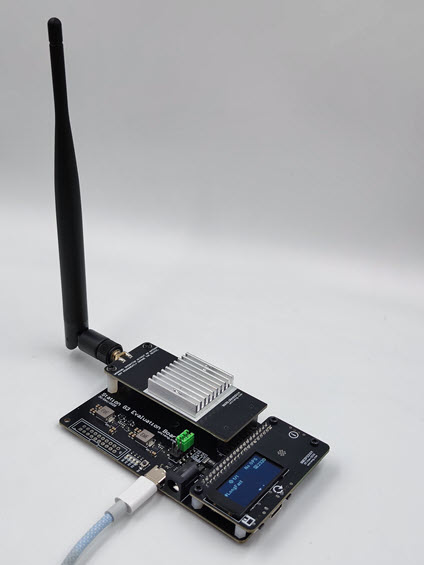
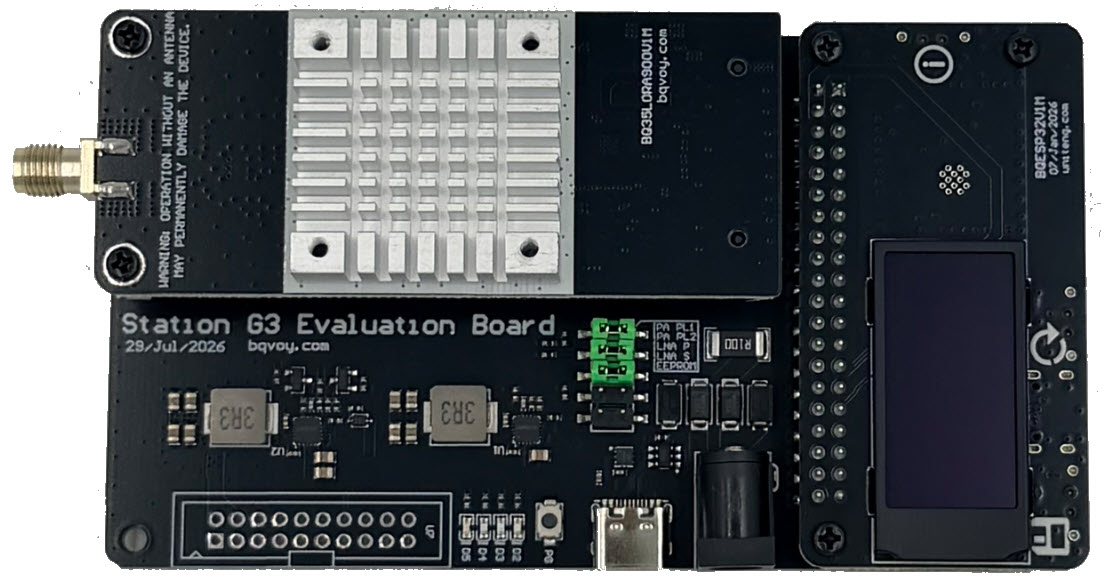
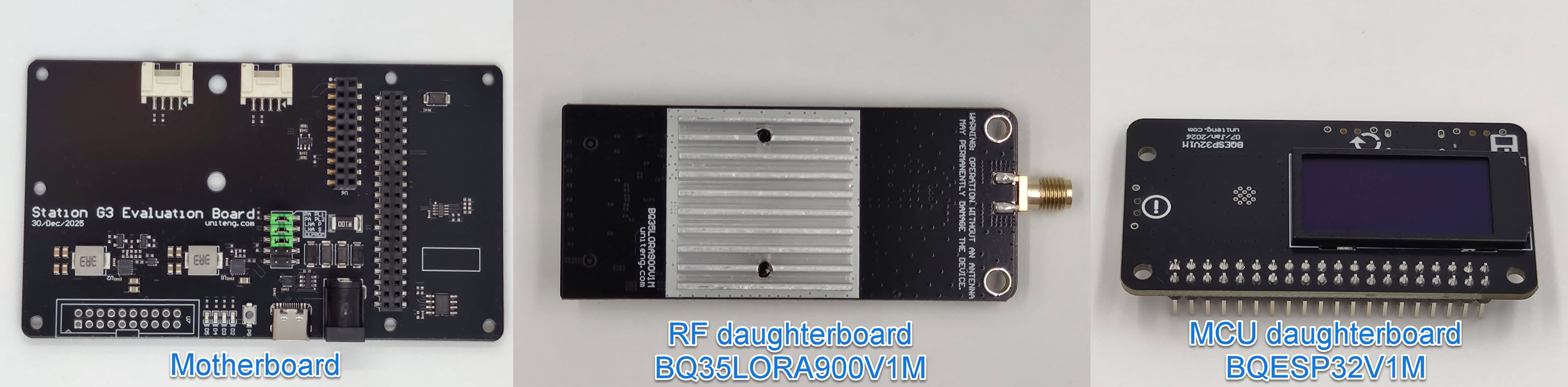
The Station G3 – ESP32S3-BQ35LORA900V1M is a modular development board that includes a motherboard, an RF daughterboard, and an MCU daughterboard, making it possible to configure/upgrade each daughterboard individually. We believe this will help extend the lifecycle of RF designs and make it easier for more engineers to integrate Station G3 into their designs.
The MCU daughterboard socket is compatible with the standard Raspberry Pi 40-pin GPIO header definition. Experienced users can use the Raspberry Pi Zero 2W with Header as an MCU daughterboard to build their own Linux Mesh nodes [More Info].
This configuration is fully compatible with Station G2 at the firmware level and can directly use most Station G2 firmware.
Package/lot:
- Motherboard x 1
It employs the same Fast-Transient DC-DC for LoRa Power Amplifier technology as the Station G2, providing excellent power support to ensure the correct transmission and reception of LoRa packets. - MCU daughterboard – BQESP32V1M x 1
This module is built using an ESP32 S3 (Flash: 16MB, PSRAM: 8MB) and a 1.3-inch OLED screen. - RF daughterboard – BQ35LORA900V1M x 1
Supports the 850 MHz–930 MHz frequency band, featuring a up to 35 dBm PA for transmit and LNA design with dynamic gain control and impedance matching for receive.
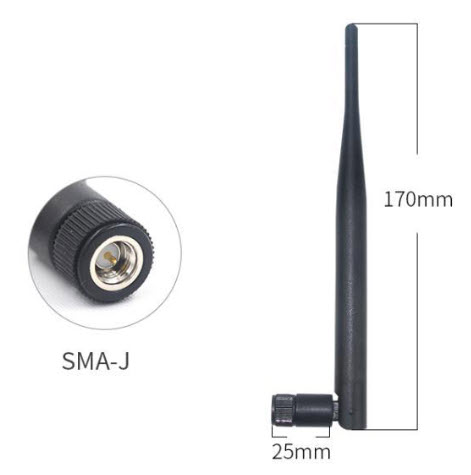
- Lora Antenna x 1
915Mhz Antenna for Region Option=US915Mhz
OR
868Mhz Antenna for Region Option=EU868MHz
Users will receive a pre-assembled development board as shown in the image below:
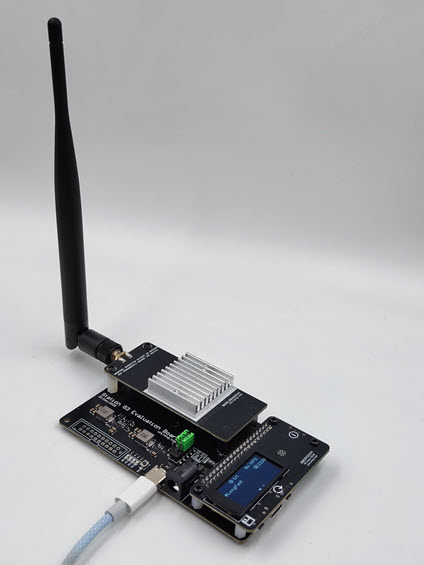
Note: the USB cable is not included in the package.
Typical RF Performance
| Item | Description |
|---|---|
| Lora Operation Frequency | 815 Mhz to 940 Mhz |
| Lora Max RF Output Power | RF daughterboard BQ35LORA900V1M: Up to 35 dBm (Max RF Output Power for Non-Boost Mode) |
| PA Operating Mode | 4 Configurable Power Levels |
| Lora Ultra-Low Noise Figure LNA | Typical Gain: 10dB – 16 dB Dynamic Gain, Typical Noise Figure: 1.5 dB |
| LNA Operating Mode | ON/OFF with Dynamic Gain & Impedance Matching |
| LoRa Transceiver | SX1262 |
| High-Precision Frequency Reference for Lora | 32MHz TCXO (+-1.5 ppm) |
| WIFI | YES |
| Bluetooth | v5.0 |
Note: The Lora RF Output Power preset to 30dBm as default for operation with license-free ISM band. [Info For Geeks]
Features Comparison of Station G2 and Station G1
| Editions | Station G3 | Station G2 |
|---|---|---|
| Core Research Areas | Adaptive LNA Control (Dynamic Gain/Impedance Matching & Disable) Modular Architecture |
Ultra-Low Noise Figure LNA for LoRa Fast-Transient DC-DC for LoRa PA |
| Photo | |
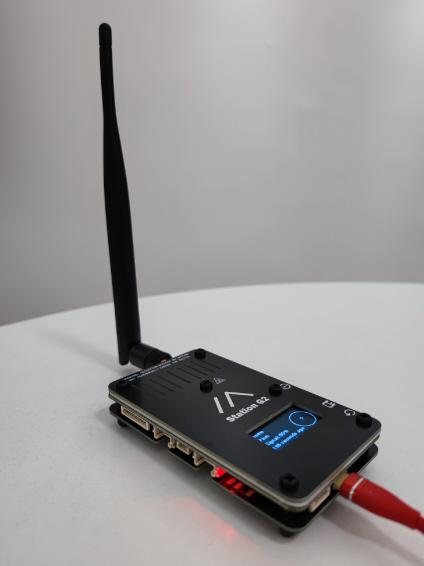 |
| Product Status | ACTIVE | DISCONTINUED |
| Current Hardware Version | 30 Dec 2025 (Motherboard) | 18 Jan 2024 |
| Initial Release Date | 30 Dec 2025 | 18 Jan 2024 |
| Lora RF Max Output Power | RF daughterboard BQ35LORA900V1M: Up to 35 dBm (Max RF Output Power for Non-Boost Mode) | Up to 35 dBm (P1dB Point) |
| PA Operating Mode | 4 Configurable Power Levels | – |
| Frequency Reference for Lora | 32MHz TCXO (+-1.5 ppm) | 32MHz TCXO (+-1.5 ppm) |
| Lora Ultra-Low Noise Figure LNA | Typical Gain: 10dB – 16 dB Dynamic Gain, Typical Noise Figure: 1.5 dB | Typical Gain: 18.5 dB, Typical Noise Figure: 1.8 dB |
| LNA Operating Mode | ON/OFF with Dynamic Gain & Impedance Matching | – |
| Fast-Transient DC-DC for LoRa PA | Transient Response Time < 18us, Maximum Transient Voltage Deviation < 275mV, Phase Margin > 66.73 Degrees, Ripple < 30mV, Test Condition: 0A-3A@7.5VDC Dynamic Test, Input Voltage 15VDC | Transient Response Time < 18us, Maximum Transient Voltage Deviation < 275mV, Phase Margin > 66.73 Degrees, Ripple < 30mV, Test Condition: 0A-3A@7.5VDC Dynamic Test, Input Voltage 15VDC |
| LoRa Transceiver | SX1262 | SX1262 |
| Lora Operation Frequency | US915MHz / EU868MHz | US915MHz / EU868MHz |
| Modular Architecture | Yes (Motherboard + RF/MCU Daughterboards) | – |
| MCU (Default) | ESP32 S3 (Flash: 16MB, PSRAM: 8MB) | ESP32 S3 (Flash: 16MB, PSRAM: 8MB) |
| MCU Daughterboard Interface | Raspberry Pi compatible 40-pin GPIO | – |
| Linux-Native Support | Optional (Raspberry Pi Zero 2W compatible) | – |
| WIFI | YES for ESP32 S3 (BQESP32V1M) | YES |
| Bluetooth | v5.0 for ESP32 S3 (BQESP32V1M) | v5.0 |
| Satellite Navigation | Optional for experienced users | Optional (1x GROVE GPS Socket) |
| USB Connector | Type C (PD Protocol) | Type C (PD Protocol) |
| Screen (Default) | 1.3 Inch OLED Screen for ESP32 S3 (BQESP32V1M) | 1.3 Inch OLED Screen |
| Power Input Socket | 15VDC USB Type C PD protocol, DC5521 Socket (9VDC-19VDC, min 25W) | 15VDC USB Type C PD protocol, 1x5P Pitch=1.5mm Socket (9VDC-19VDC External Power Supply) |
| LoRa Antenna | SMA Socket | SMA Socket |
| Accessories | 1x GROVE GPS, 1x GROVE I2C for experienced users | 1x GROVE GPS Socket, 1x GROVE I2C Socket, 1x SparkFun QWIIC I2C Socket and 1x IO Extension Socket |
| Typical Scenarios | Fixed-Location Base Stations, Vehicle-Mounted Base Stations, Linux Development Nodes | Fixed-Location Base Stations and Vehicle-Mounted Base Stations |
Use Cases
Due to the excellent Lora transmission/reception performance of Station G3, Station G3 is used to build backbone mesh networks in many regional Mesh communities.
Featuring an Advanced RX LNA Architecture with dynamic gain control, dynamic impedance matching, and an LNA bypass/disable function, the RF daughterboard – BQ35LORA900V1M empowers the system to achieve superior compatibility with high-gain monopole antennas in high-noise environments. It decisively outperforms the Station G2 in both co-channel interference mitigation and dynamic range, allowing the Mesh network to capture even weaker signals from low-power nodes, ultimately ensuring broader coverage and rock-solid network stability.
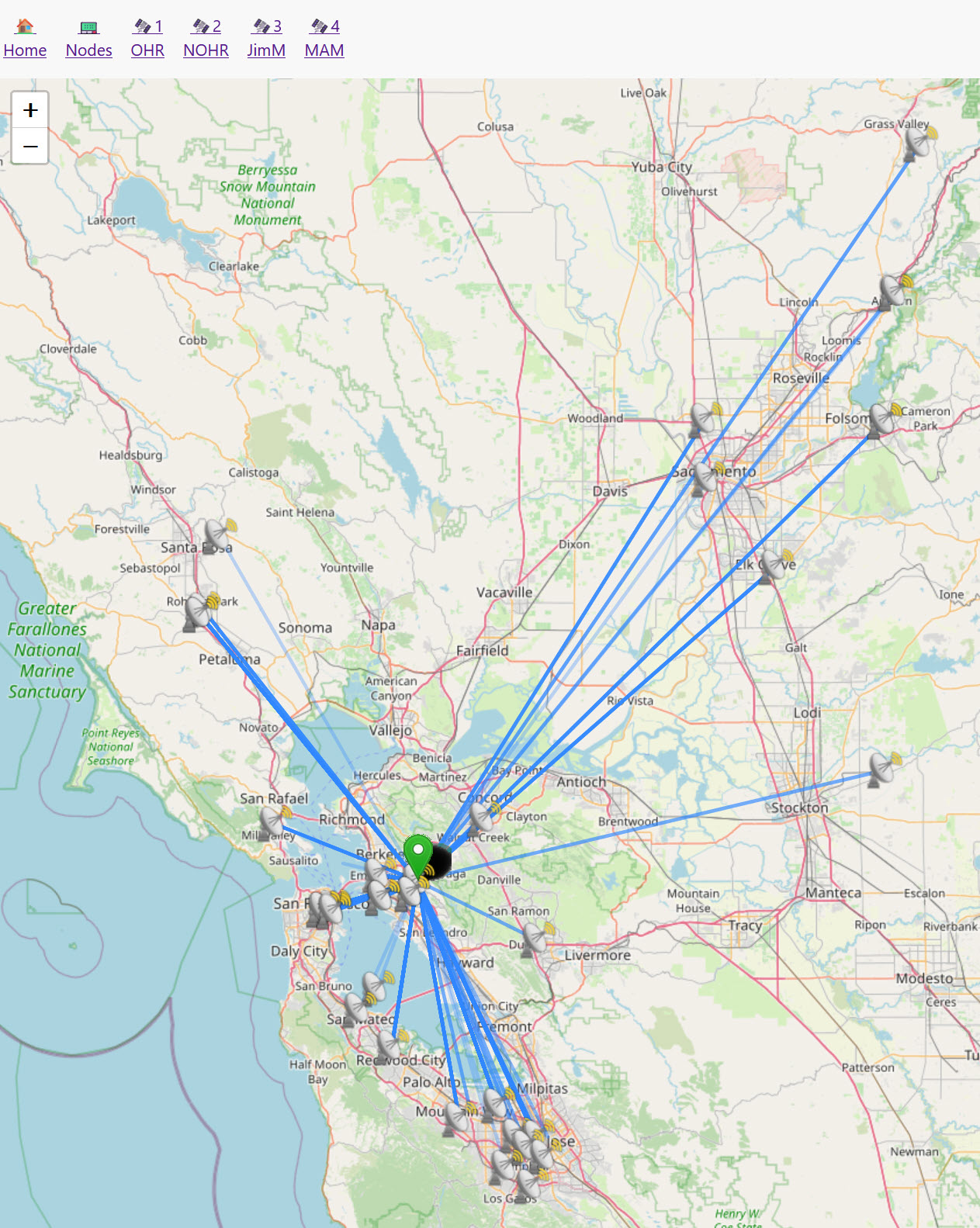
The following figure shows a typical coverage map of Station G2 OHR node deployed by Meshtastic Bay Area Group in California. (Screenshot taken on 18-Jul-2024):
Amateur Radio Notice
This device operates in the 33 cm amateur band (US915 MHz) and can transmit above 1 W.
Use above this level requires operation under an FCC Amateur Radio license (Part 97) and compliance with all applicable technical limits. Users in other countries must follow their own national regulations. [More Information]
Reviews
There are no reviews yet.